
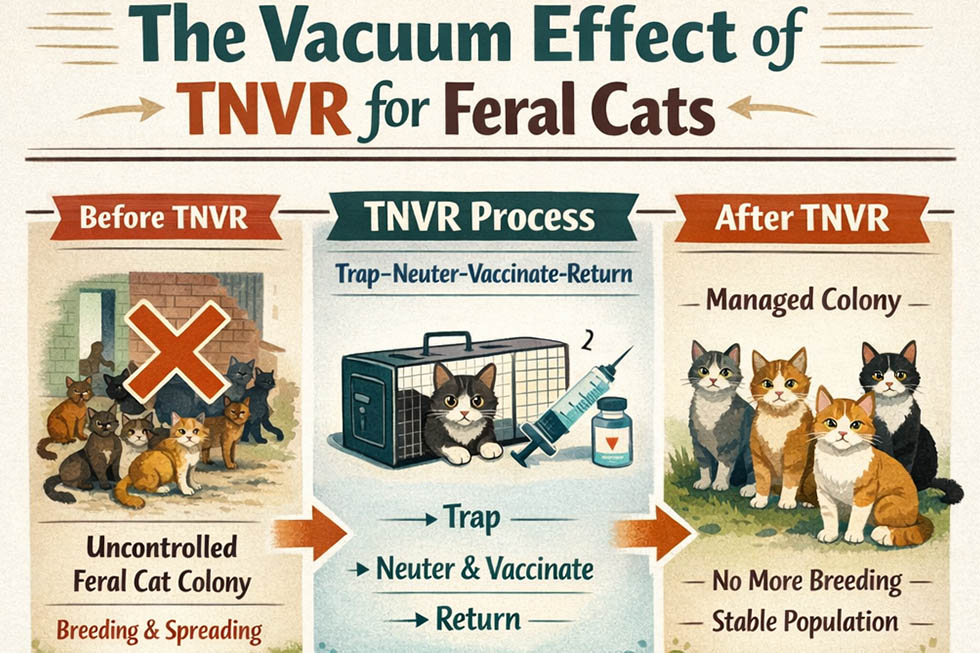
TNVR stands for Trap-Neuter-Vaccinate-Return. It’s a humane way to manage community cat populations. Cats are safely trapped, spayed or neutered, vaccinated, ear-tipped for identification, and then returned to the outdoor area they already know. Animal welfare groups and community cat programs support this approach because it helps stop new litters from being born, while also improving the health and stability of the colony.
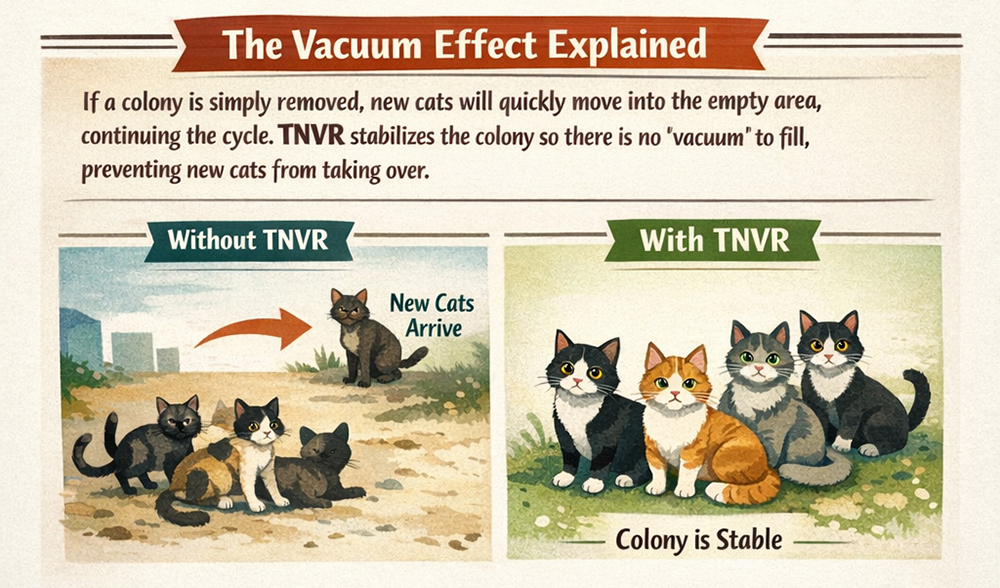
One of the most important reasons TNVR works is because it addresses something called the “vacuum effect.” The vacuum effect happens when cats are removed from an area, but the food, shelter, and habitat remain. That open space doesn’t stay empty for long. Other unsterilized cats often move in or surviving cats breed to fill the gap. As a result, simply trapping and removing cats does not solve the problem. The population often returns, and the cycle starts all over again.
TNVR helps prevent the vacuum effect because the cats are returned to their original territory after surgery and vaccination. Since they are already living in that space, they help keep new cats from moving in. Because they’ve been sterilized, they no longer produce kittens. Over time, the colony becomes smaller through natural attrition, meaning the number of cats slowly declines without the constant birth of new litters. This is why TNVR is often seen as both more humane and more effective than repeated removal.
TNVR can also improve life in the neighborhood. When cats are sterilized, behaviors linked to mating often decrease. That can mean less yowling, less fighting, less spraying, and fewer nuisance complaints. Vaccination also improves protection against disease, and caregivers can better monitor the cats’ conditions. In many communities, TNVR has been used not only to help cats, but also to reduce shelter intake and lower the strain on local animal services.
The vacuum effect is a simple but powerful idea. If the environment stays attractive to cats, removing cats alone usually creates an empty space that other cats will fill. TNVR breaks that cycle. Instead of creating a revolving door of new animals, it stabilizes the existing colony and prevents reproduction. For communities looking for a practical and compassionate answer to outdoor cat populations, understanding the vacuum effect shows why TNVR is such an important part of long-term population control.
Information from https://bestfriends.org/pet-care-resources/community-cat-trap-neuter-vaccinate-return-tnvr-success-stories and https://www.alleycat.org/our-work/trap-neuter-return