
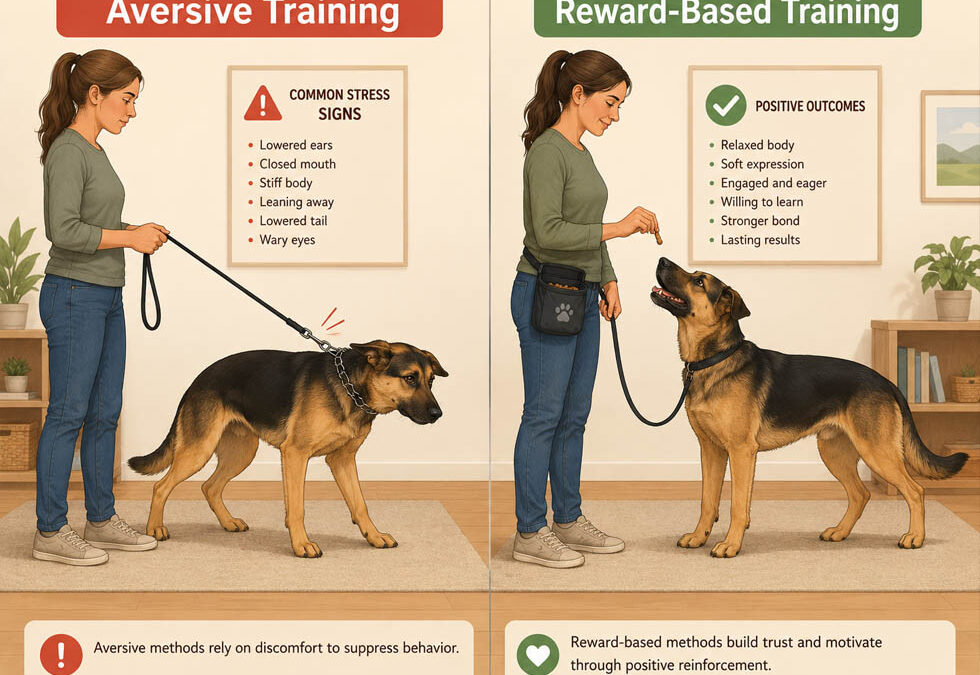
Training should help dogs feel safe, learn good habits, and build trust with their people. Tools such as prong collars, shock or vibration e-collars, choke chains, invisible fencing, and retractable leashes may look like quick fixes, but they can create bigger problems over time.
Many animal behavior and veterinary groups recommend reward-based training instead. Reward-based training teaches dogs what we want them to do, rather than using pain, fear, or discomfort to stop what we do not want. The American Veterinary Society of Animal Behavior says reward-based training is supported by evidence and should be used for all canine training. It also says tools that involve pain, such as choke chains, prong collars, and electronic shock collars, should be avoided.[1]
These Tools Can Create Fear Instead of Learning
A dog may stop pulling, barking, or running because the tool hurts, scares, or startles them. But stopping a behavior is not the same as learning a better one.
For example, if a dog feels pain from a prong collar when a child walks by, the dog may connect the pain with the child. The dog may then become afraid of children, even if the child did nothing wrong. The RSPCA explains that prong collars can cause dogs to connect pain with things around them, which can lead to new behavior problems. [2] The same problem can happen with shock collars, vibration collars, and invisible fences. The dog may not understand why the correction happened. They may only learn that walks, people, other dogs, the yard, or their owner are scary.
They Can Increase Anxiety, Stress, and Aggression
Aversive tools can make dogs more anxious and less secure. The American Animal Hospital Association says aversive training has been linked with harm to the human-animal bond, problem-solving ability, and a pet’s physical and behavioral health. It also warns that aversive methods can be especially harmful for fearful or aggressive animals because they may suppress warning signs, making the dog more dangerous. [3] That is important because growling, backing away, freezing, or barking can be warning signs. If punishment stops those warning signs, the dog may still feel afraid, but people may not see the warning before a bite happens.
Prong Collars and Choke Chains Can Cause Physical Harm
Prong collars and choke chains put pressure on a dog’s neck. The neck is a sensitive area that includes the throat, windpipe, thyroid glands, muscles, nerves, and spine. The RSPCA states that prong collars are designed to cause pain or discomfort, and the prongs can cause pain, injury, puncture wounds, infection, and nerve damage. It also notes that repeated pressure from choke chains and prong collars can cause inflammation, coughing, windpipe injury, cervical spine injuries, and thyroid gland injury. [4] Even if the dog stops pulling, the cost can be fear, pain, and damage to trust.
Shock and Vibration E-Collars Can Backfire
Electronic collars are often described as “stimulation,” “static,” or “vibration,” but they are still used to interrupt or stop behavior through discomfort, surprise, or fear. Research summarized by AVSAB found no difference in effectiveness between remote electronic shock collars and reward-based methods for teaching recall or stopping chasing, even when experienced trainers were involved. AVSAB also notes that dogs trained with aversive methods can show more stress-related behaviors and that reward-based methods are more effective overall. [5] There is one important note: a vibration collar can sometimes be used humanely as a communication cue for a deaf dog, but only when it is gently introduced and paired with rewards. That is very different from using vibration as a punishment.
Invisible Fences Do Not Truly Protect Dogs
Invisible fences use a collar that warns and then shocks or corrects the dog when they approach a boundary. The problem is that the fence does not create a real barrier. An invisible fence may keep some dogs in, but it does not keep other dogs, wildlife, strangers, or children out. The Pet Professional Guild explains that electronic fences leave dogs unprotected from people, animals, teasing, theft, attacks, or unsafe items tossed into the yard.[6] Invisible fences can also fail when a dog is highly excited. A dog may run through the boundary to chase a squirrel, cat, bike, person, or another dog. Then the dog may be afraid to come back because returning means crossing the shock zone again. PetMD also notes that invisible fence collars can cause neck wounds, infections, burns, fear of the yard, escape risk, and behavior problems. [7]
Retractable Leashes Can Teach Pulling and Reduce Safety
Retractable leashes are not usually called “training tools,” but they can still create training and safety problems. They allow a dog to move far away from the person holding the leash. If another dog appears, a car passes, or the dog grabs something dangerous, the person may not be able to react quickly enough. Santa Barbara Humane warns that retractable leashes do not provide enough control, can allow dogs to dart into traffic or eat something toxic, can break or tangle, and can encourage pulling because the leash stays tight. A regular 4- to 6-foot leash gives better control and helps teach calm walking.
Better Choices for Dogs and People
Humane training is not about letting dogs do whatever they want. Dogs still need rules, structure, and practice. The difference is that we teach those rules without pain or fear. Better choices include:
- A well-fitted harness.
- A regular 4- to 6-foot leash.
- Reward-based loose-leash walking.
- A secure physical fence or supervised outdoor time.
- Management tools such as baby gates, crates, pens, window film, or safe rooms.
- Help from a qualified reward-based trainer or veterinary behavior professional.
The ASPCA supports training methods based on kindness, respect, lures, food, praise, petting, and play. It also opposes training equipment that causes physical discomfort or undue anxiety.
The Bottom Line
Dogs do not need pain, fear, or intimidation to learn. They need clear communication, patience, safety, and rewards for the behaviors we want to see. Prong collars, shock and vibration e-collars, choke chains, invisible fencing, and retractable leashes may seem convenient, but they can cause injury, stress, fear, confusion, aggression, and damaged trust. Reward-based training takes time, but it helps dogs learn in a way that is safer, kinder, and more effective for the long term.
- AVSAB: Humane Dog Training Position Statement-2021.pdf and AVSAB Position Statements
- RSPCA: Why prong collars are harmful to dogs
- AAHA: Changing Behaviors Aversive Techniques
- RSPCA Why prong collars are harmful to dogs
- AVSAB: Humane Dog Training Position Statement-2021.pdf and AVSAB Position Statements
- Pet Professional Guild: Electronic Fences – What You Need To know
- PetMD: 7 Reasons Why Invisible Fences for Dogs Don’t Work
- Santa Barbara Humane: The Dangers of Retractable Leashes
- ASPCA: Position Statement on Training Aids and Methods