
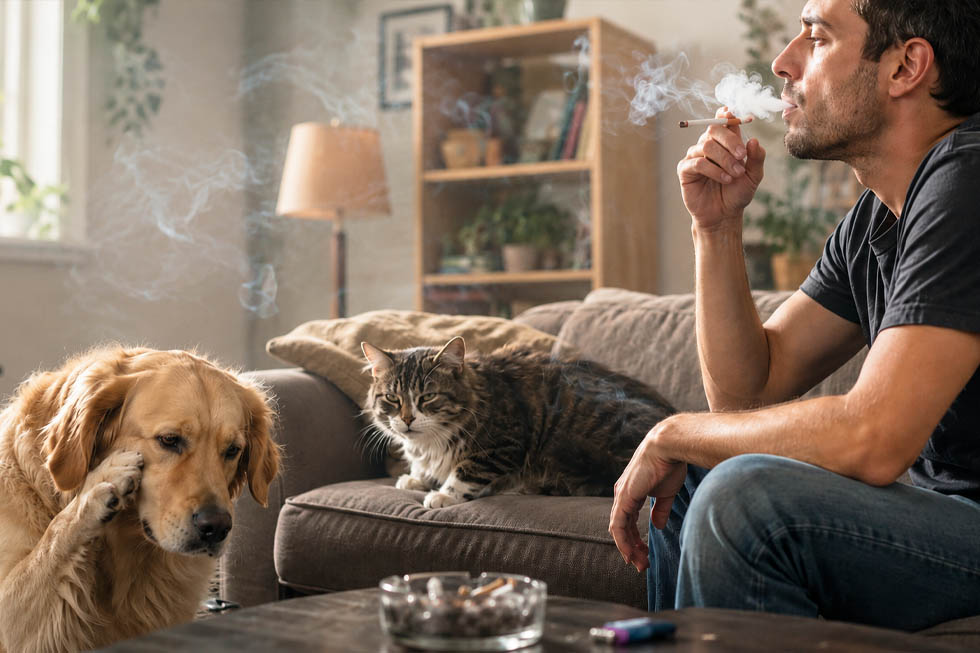
Most people know that smoking indoors can be harmful to people. But many pet owners do not realize it can also hurt dogs and cats. Dogs and cats breathe the same indoor air as we do. When someone smokes inside, pets can breathe in secondhand smoke. They can also be exposed to thirdhand smoke, which is the smoke residue that sticks to furniture, carpet, clothing, bedding, walls, and even a pet’s fur. [1]
Why Indoor Smoke Is Risky for Pets
Dogs and cats are smaller than people, so smoke can affect them quickly. They also spend a lot of time close to the floor, where smoke particles and residue can settle. If they sleep on smoky furniture or rugs, they can be exposed for many hours a day. [1] Dogs exposed to secondhand smoke may have more coughing, eye irritation, allergies, and breathing problems. Some studies have also linked smoke exposure to nasal and lung cancers in dogs. [2]
Cats have another problem. They groom themselves by licking their fur. If smoke residue lands on their coat, they may swallow those chemicals when they clean themselves. Smoke exposure has been linked to higher risks of lymphoma and oral cancer in cats. [3]
Thirdhand Smoke Matters Too
Even if someone smokes in another room, smoke residue can still travel through the home. It can stick to curtains, blankets, pet beds, toys, and clothing. This is called thirdhand smoke. That means opening a window or using a fan may not fully protect pets. It may reduce the smell, but it does not remove all the chemicals that settle on surfaces. [1]
Cigarettes, Cigars, Pipes, Vapes – Nicotine in General
Any indoor smoke can irritate a pet’s lungs. Cigarettes, cigars, and pipes can all create secondhand and thirdhand smoke. Vaping can be a concern, especially if pets get into e-liquid, or cartridges. Nicotine gum, nicotine patches, or cigarette butts can also be trouble. Pet Poison Helpline says nicotine can act quickly, and dogs or cats may show signs of poisoning within 15 to 60 minutes after swallowing it. [4] Signs of nicotine poisoning may include vomiting, diarrhea, agitation, fast heart rate, fast breathing, weakness, shaking, seizures, or collapse. If you think your dog or cat ate a cigarette, cigarette butt, vape cartridge, nicotine gum, nicotine patch, or e-liquid, call your veterinarian or a pet poison hotline right away. [4]
What Pet Owners Can Do
The safest choice is to keep your home smoke-free. Smoke outside, away from doors and windows, and wash your hands afterward. Wash pet bedding often. Keep ashtrays, cigarette butts, vape products, nicotine gum, and patches far out of reach. It is also a good idea to watch for small changes in your pet’s health. Coughing, wheezing, watery eyes, sneezing, low energy, or changes in appetite should be discussed with your veterinarian.
A Smoke-Free Home Is a Healthier Home
Dogs and cats depend on us to keep their home safe. They can’t choose where they live, what air they breathe, or what chemicals land on their fur and bedding. Keeping smoke out of the house is one simple way to protect them. It helps their lungs, their comfort, and their long-term health. For many pet owners, the love they have for their dog or cat can also be a strong reason to smoke less, smoke outside, or take steps toward quitting.
[1] Be Smoke-free and Help Your Pets Live Longer, Healthier Lives (USFDA)
[2] The Effects of Secondhand Smoke on Pets (VCA Animal Hospitals)
[3] Secondhand Smoke & Pets (BREATHE | University of Kentucky)
[4] Nicotine” and “Nicotine Ingestion in Pets (petpoisonhelpline.com)